

Even in the mid-20th century, engine power, measured in the then-unusual unit of "horsepower," was the most important technical characteristic of vehicles. Even during World War II, a significant portion of freight traffic was carried by horse-drawn carts; horses required oats for feeding, so food was in much greater shortage than liquid fuels.
It was only in the early 1970s, after a sharp rise in the price of oil and its derivatives, that vehicle manufacturers first turned their attention to such a now-important parameter as fuel consumption per 100 kilometers. Minimizing it promised certain advantages in competing with rivals for sales markets for their products.
As subsequent developments demonstrated, this approach ultimately became crucial to success. Those uninitiated in technical nuances were perplexed by the fact that Japanese cars were steadily displacing giant US corporations in the American market, while in the former Soviet bloc countries, Soviet aircraft were being replaced by Brazilian ones, even though both countries had been acknowledged leaders in scientific and technological development in the opposing camps during the Cold War.
The problem became clear and obvious only with the pressing need to transition from traditional internal combustion engines to more environmentally friendly electric ones. For the former, increasing the fuel tank size to the required volume was relatively straightforward, but the same cannot be said for batteries, so the already pressing issue of energy conservation became extremely pressing.
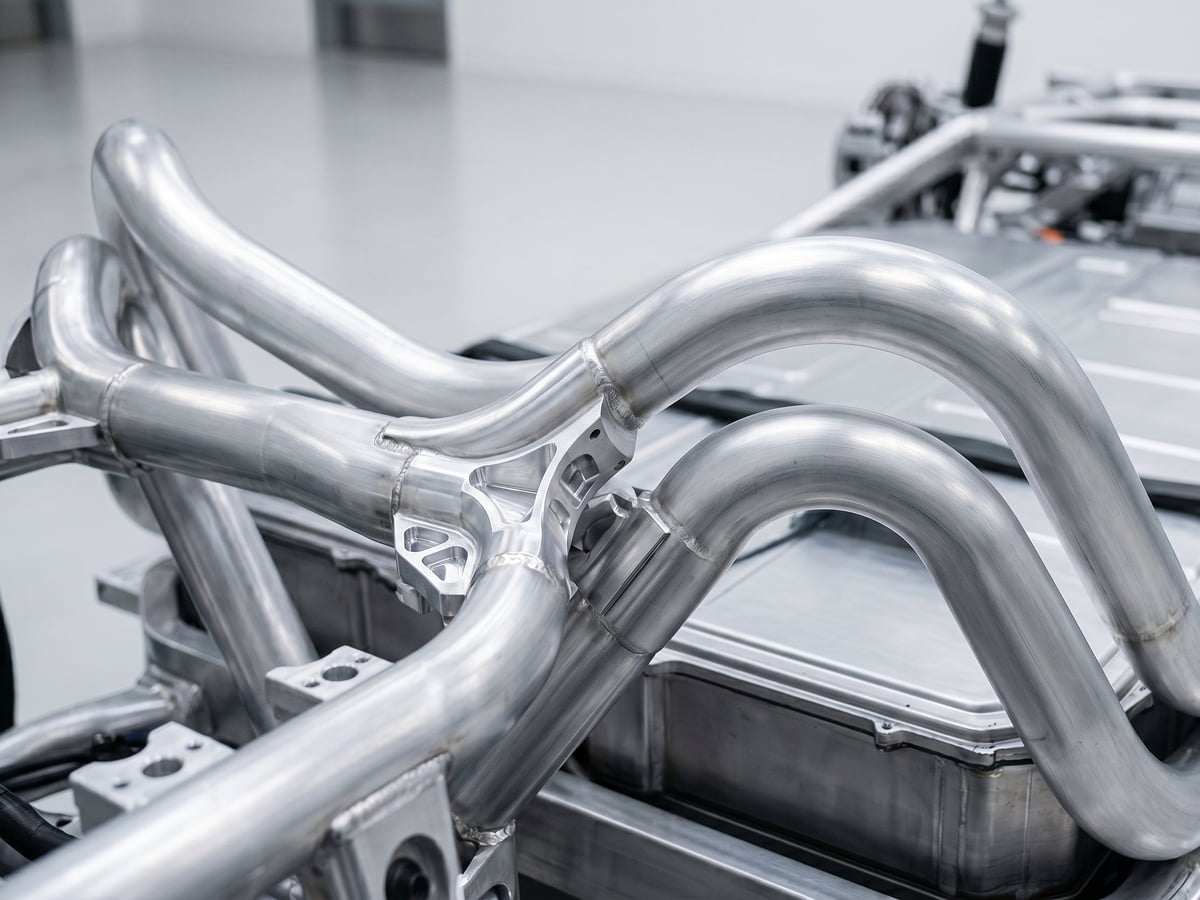
According to conservation laws familiar from school, energy is directly proportional to the mass of the accelerated body, so there was an urgent need to minimize it. Therefore, in addition to searching for new solutions, engineers were forced to pay closer attention to certain materials, although traditional, that were little used in vehicle construction. In particular, increased market demand for aluminum pipe, previously used mainly in agriculture and aircraft manufacturing.
Advantages and disadvantages of aluminum pipes in transport construction
To understand the role of aluminum pipes in modern transport construction, let's consider several characteristic features:
- As mentioned above, the use of this material allows for a significant reduction in the overall weight of the structure, which is necessary to solve the main problem of energy saving.
- Due to its high plasticity, aluminum products bend easily to small radii while maintaining structural integrity. This not only facilitates the production of intricately shaped parts, but also, due to their diversity, helps to compact the prefabricated structure for more efficient use of available space.
- The source of significant limitations on applicability is insufficient strength.
This defect can be combated by introducing alloying additives into the source raw material or by replacing it with analogues more suitable for solving specific problems.
Titanium pipe
Significantly increasing the reliability of components and assemblies without increasing weight allows for similar weights with identical dimensions titanium pipe In terms of strength and wear resistance, it surpasses even steel and is not widely used only due to its relatively high cost, being limited to a narrow range of specific applications. Titanium is highly resistant to both impact and gentle mechanical loads, as demonstrated by the hulls of deep-sea submersibles and the life-saving protective halos for Formula 1 drivers' heads. Another valuable quality is its exceptional heat resistance, which proves useful when operating in extremely high-temperature environments, such as in the exhaust systems of piston and turbojet engines.
Brass pipe
To transfer thermal energy from one medium to another without mixing them, heat exchange equipment is required, for the manufacture of which heat exchangers are often used brass pipe Due to high thermal conductivity and thin wall thickness, as well as the absence of corrosion and scale deposits on the smooth surface, the efficiency of the best units approaches 100%, the time spent on the entire process is minimal, and the reliability of the separating barrier between the coolant and the external environment ensures trouble-free operation for decades.