

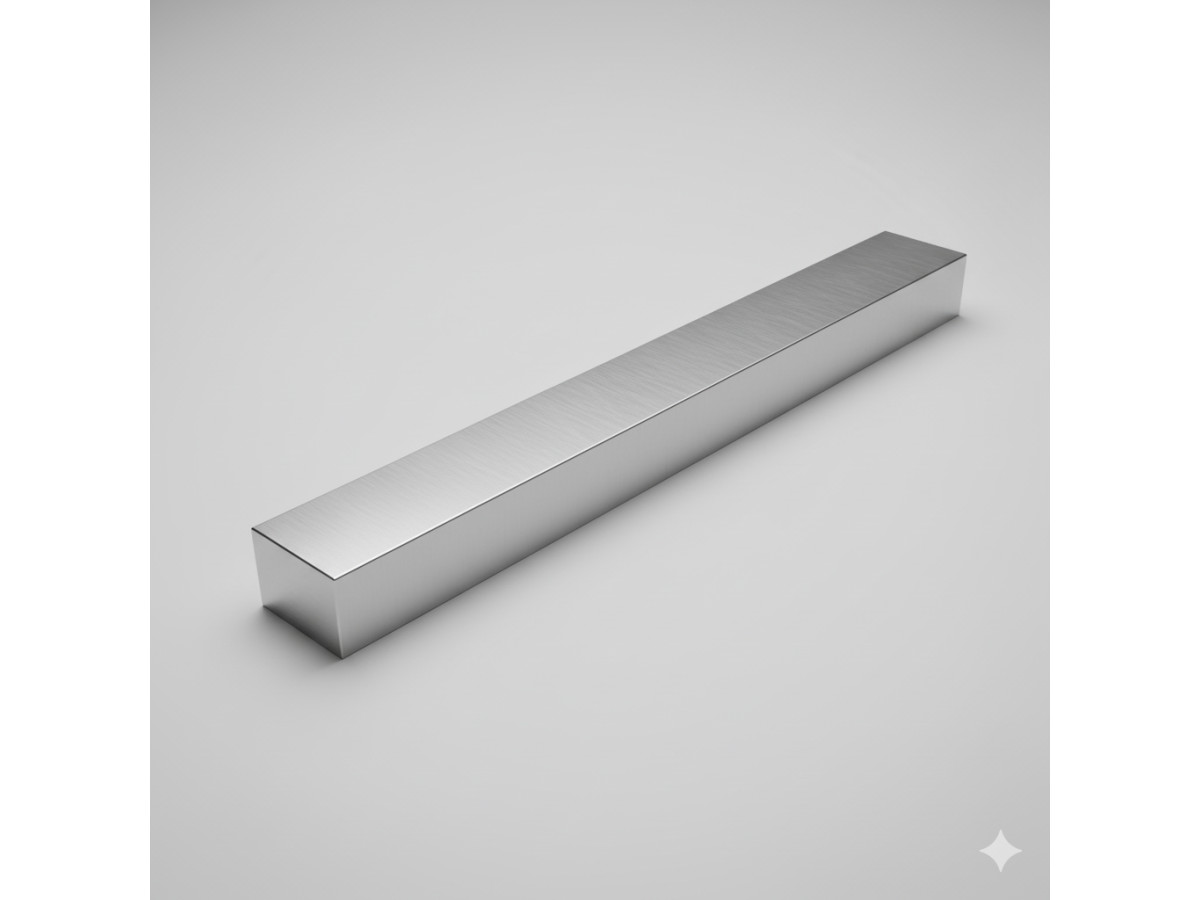
In the production of various structural materials, standards are used that specify permissible deviations from the ideal dimensions and geometric shapes. The higher the precision of a product, the more complex and expensive the manufacturing methods used to produce it. However, they allow for greater efficiency in solving complex practical problems. As a demonstration of the benefits achieved, consider the following in detail.
included in the group of ferrous rolled metal products produced by metallurgical enterprises calibrated steel square.
Of its valuable distinctive properties, it is enough to list the following:
The strictly parallel, precisely spaced opposite edges obtained through calibration ensure a uniform thickness along the entire length of a straight, long rod. This ensures that, no matter where a piece is cut, all will have a uniform square cross-section with a precisely defined side dimension. This is crucial in the creation of high-precision machine frames, machine and mechanism components, as well as templates and reinforcing inserts used in the construction of various brickwork structures.
Depending on the steel grade used for rolled product production, each grade has its own unique set of properties. This allows engineers to select the optimal mechanical properties for each specific application, focusing in some cases on impact resistance due to increased toughness, and in others on increased resistance to compressive deformation due to high hardness.
All grades of structural steel are relatively easy to join using automatic or manual arc welding. For installation, simple equipment is sufficient, without the ability to achieve special current modes by converting AC line voltage through rectification using diode bridges or changing the frequency by passing electricity through expensive semiconductor circuits. There is also no need for additional protection against metal oxidation by atmospheric air, as it is displaced from the weld pool by a jet of inert gas supplied from bulky cylinders.
For comparison, it is useful to consider some analogs of a calibrated steel square in order to understand the feasibility of using one or another material in each specific case.
Practical application of calibrated steel square analogues
Having a cost that is one and a half times lower hot-rolled steel square It doesn't have the same dimensional and geometric precision as calibrated steel, making it unsuitable for the manufacture of high-precision equipment. However, it's a preferable base material for less critical metal structures, as it allows for significant savings in startup costs. More expensive alternatives may be needed for specific applications, two of which are worth discussing separately.
Stainless steel square
In the chemical and food industries, equipment is exposed to highly reactive acids, alkalis, strong salt solutions, and organic compounds. These conditions necessitate materials resistant to undesirable oxidation-reduction reactions. For this reason, acetylene is in high demand in the production of equipment for these industries stainless steel square, reliably protected from destruction by a tightly adhering thin layer of oxide present on the surfacechemical compositionas an alloying additive of chromium.
Electric-welded profile steel pipe
Relatively inexpensive electric-welded profile steel pipe It differs from a calibrated square by its internal cavity. Due to this cavity, sections of the same length, even with identical external dimensions, differ significantly in weight. This not only simplifies the structure of the metal structure, as it is much less susceptible to deformation under its own weight, but also significantly reduces the cost of its manufacture. By using similar steel grades as the raw material for production, all the inherent advantages during installation are preserved, and fastening the sheet materials used as the cladding is even easier thanks to the ability to use self-tapping screws that are screwed into the base.