

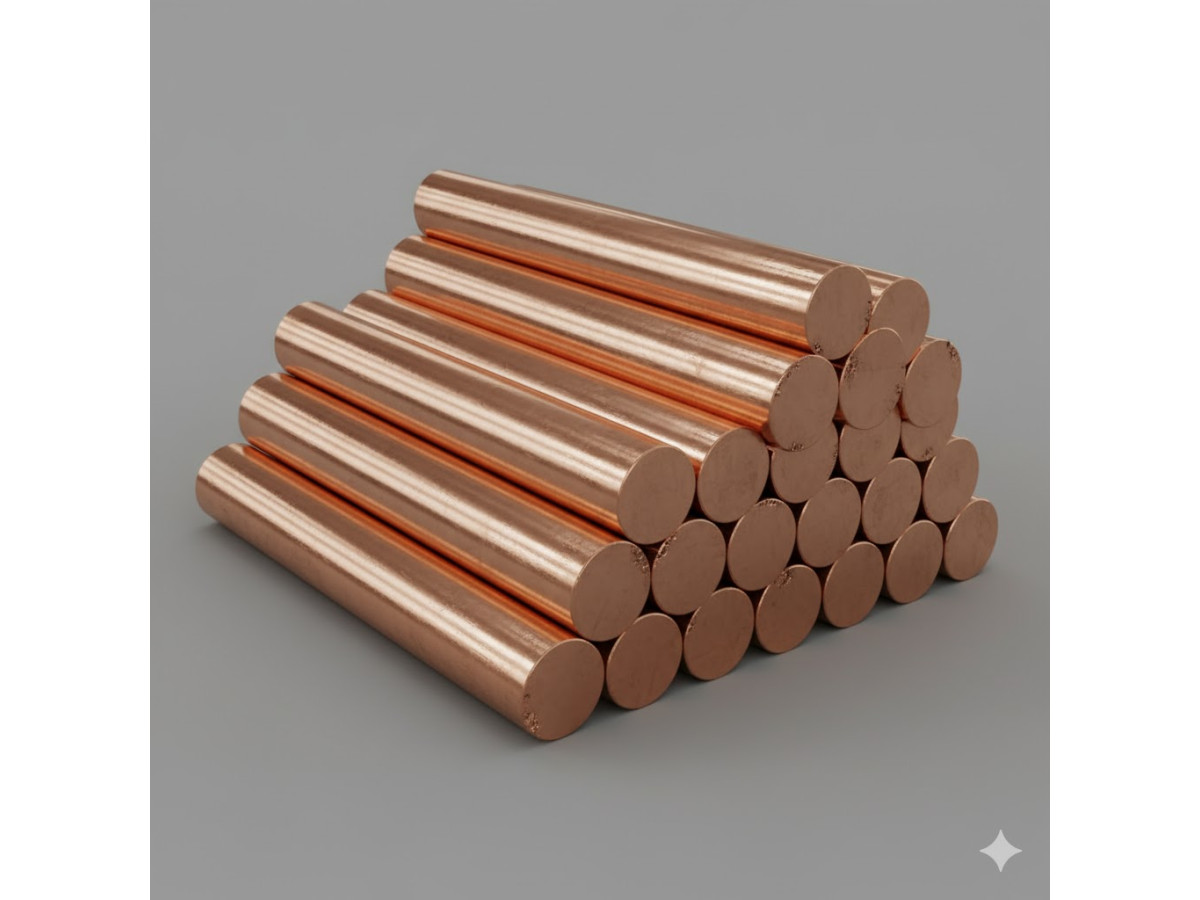
It belongs to a group of typical non-ferrous rolled products and is produced in large quantities annually by Ukrainian metallurgical plants according to proven standards developed in the last century. To achieve the desired geometric shape, cold or hot forming on rolling mills and drawing through calibration holes are used. This latter process achieves a cross-sectional shape that is virtually perfect for the turning process. The blanks, which initially possess central symmetry, are characterized by a uniform mass distribution, so even without preliminary roughing, they do not introduce bearing-damaging imbalances into the machine tool operation that can distort shafts. Thus, machining can begin immediately at high rotational speeds, significantly accelerating the work process and significantly increasing lathe operator productivity. Other features of copper round bars include:
In addition to turning parts, rods are also quite suitable for use without any additional processing using metal-cutting equipment. Uninsulated, bare conductors of large cross-sections are often used as contact elements to power various moving mechanisms that incorporate an electric drive to generate force on the working parts. An example is the trolleys commonly found in factory workshops used to service winches, hoists, and cranes of various designs.
Unlike steel, copper is almost impossible to join using electric arc welding, but can be soldered without any problems using lead-tin and other types of solders.
The manufacture of critical components sometimes requires a material with a very high degree of purity, removing impurities that could impair certain technical characteristics. For this purpose, raw copper is anodized by casting cathodes and immersing them in a container of electrolyte. After applying voltage to both electrodes, electrolysis is initiated. The contaminated metal dissolves, ions pass through the membrane, and discharge at the anode, forming a cluster of neutral atoms that precipitate into a clot. After remelting, this clot yields the highest-quality raw material for the manufacture of electrical products.
In addition to the copper circle, its analogues are widely used to create parts for electrical appliances and other types of equipment, which are worth discussing separately.
Analogues of a copper circle
To understand the difference between a copper circle and its cheaper analogues, let's look at two examples.
Brass circle
The resulting copper-zinc alloy has many of the valuable qualities of the base material, but some are irrevocably lost and others are acquired in return brass circle It is slightly inferior to copper in electrical conductivity, but components made from it offer greater strength and wear resistance, which is essential for components subject to mechanical loads. Furthermore, its exceptional antifriction properties open up new possibilities, making it widely used for the manufacture of bushings, shut-off and control valve assemblies, and other components subject to intense friction.
Aluminum circle
Aluminum is one and a half times less conductive than copper, but its density is also half as low. Due to this aluminum circle In some areas, such as aviation and the rocket and space industry, it is becoming simply indispensable, while in others, it is more economically advantageous due to its lower cost and reduced expenses on supporting structures for current-carrying elements. This lightweight metal is also useful for reducing the inertia of moving parts in industrial and laboratory equipment, as well as measuring instruments.