

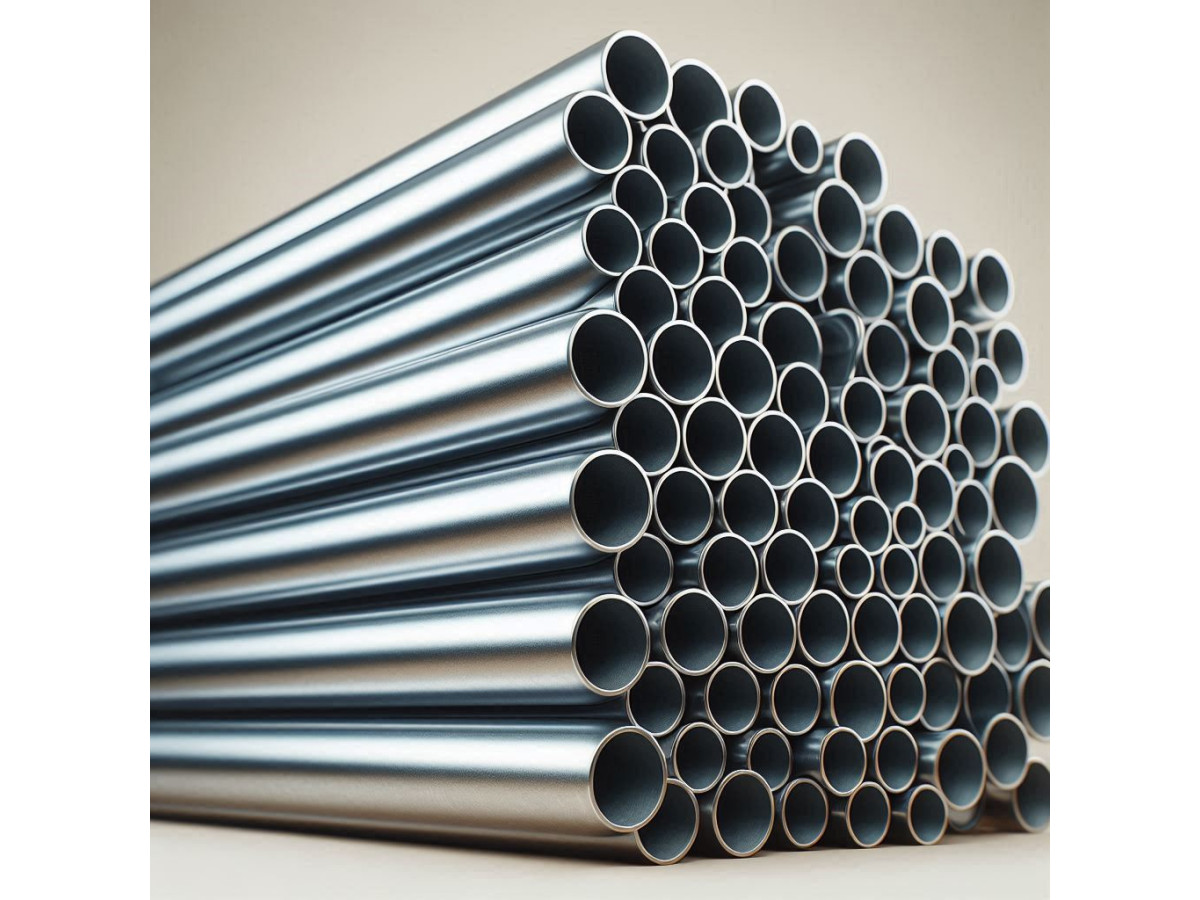
Pipeline transport currently covers more than half of the annual freight turnover in the economic activity of all countries on planet Earth. The total length of all sections of branched tree-like structures of pipelines of various diameters is enormous, so there is a steady demand for materials suitable for their construction and repair. Ukrainian metallurgical plants produce large tonnages for these purposes round hot rolled steel pipe and similar names of ferrous rolled metal products, fully covering the needs of business entities in the domestic market.
The main features of the mentioned material are:
- The solid-drawn wall has a uniform structure, so its rupture requires much greater efforts than with electric welds. This circumstance allows for higher pressure to be developed inside, which contributes to an increase in the productivity of the transport system and an increase in the efficiency of pumping stations due to the savings in energy spent on the rotation of the rotors of electric motors.
- Axial symmetry ensures the same radius of curvature at all points, which also plays an important role in the uniform distribution of forces applied in the tangential direction to the inner wall. In addition, the ideally round shape of the ring formed in the cross section, with the same diameter along the entire length, allows for the complete coincidence of the location of the edges of two specimens opposite each other to be achieved without any special troubles when joining the ends with coaxial orientation. This significantly simplifies the formation of the weld and allows for its highest quality to be achieved with minimal time expenditure, thereby increasing the pace of installation work.
- The structural steel used as the raw material for production is easily joined by conventional manual electric arc welding without rectification or frequency conversion of the mains alternating current, the use of expensive electrodes and the creation of a protective atmosphere of inert gases over the molten metal to protect it from oxidation by oxygen contained in the air. This reduces the costs of purchasing expensive equipment and consumables, as well as the involvement of highly qualified welders in the installation.
All of the listed properties are also present round cold rolled steel pipe, which differs from hot-rolled only in the technological features of production. Their cost is the same, so in most cases there is no particular difference which of them is used in the creation of highways and engineering systems. Only in those cases where the geometric shape of the grains of the metal wall, the absence of scale on the surface and other specific nuances that are understandable only to specialists are important, does it make sense to give preference to one of the two listed varieties.
Analogues of round hot rolled steel pipes
Round hot-rolled steel pipes have proven themselves very well in practice, but in order to save money, when the opportunity arises to replace them with cheaper analogues, they are usually given way to them. It is worth saying a few words about two of them separately.
Water and gas steel pipe
Having a lower price water and gas steel pipe is made by twisting a narrow flat strip at a certain angle with the side edges connected by a spiral seam. This structure, like seamless, allows bending sections of material at small radii without the risk of forming fistulas in the walls. This property is most in demand when installing utility lines inside buildings, where it is necessary to make many turns in corners or when going around obstacles, therefore this type of rolled metal is produced in small diameters, ideally suited for such purposes.
Round electric welded steel pipe
The cheapest variety is round electric welded steel pipe, also obtained by bending a narrow flat strip of metal into a cylinder around a central axis with the side ends connected using automatic electric welding. The seam is straight and very unstable to bending. It is also the weakest point of the wall when applying forces in the tangential direction. These two factors impose restrictions on the applicability of this type of pipe, which is not used when frequent pipeline turns are required or when it is necessary to operate it at pressures that are too high for welded structures. A reasonable approach will allow you to choose the material that is optimal in price and set of properties.