

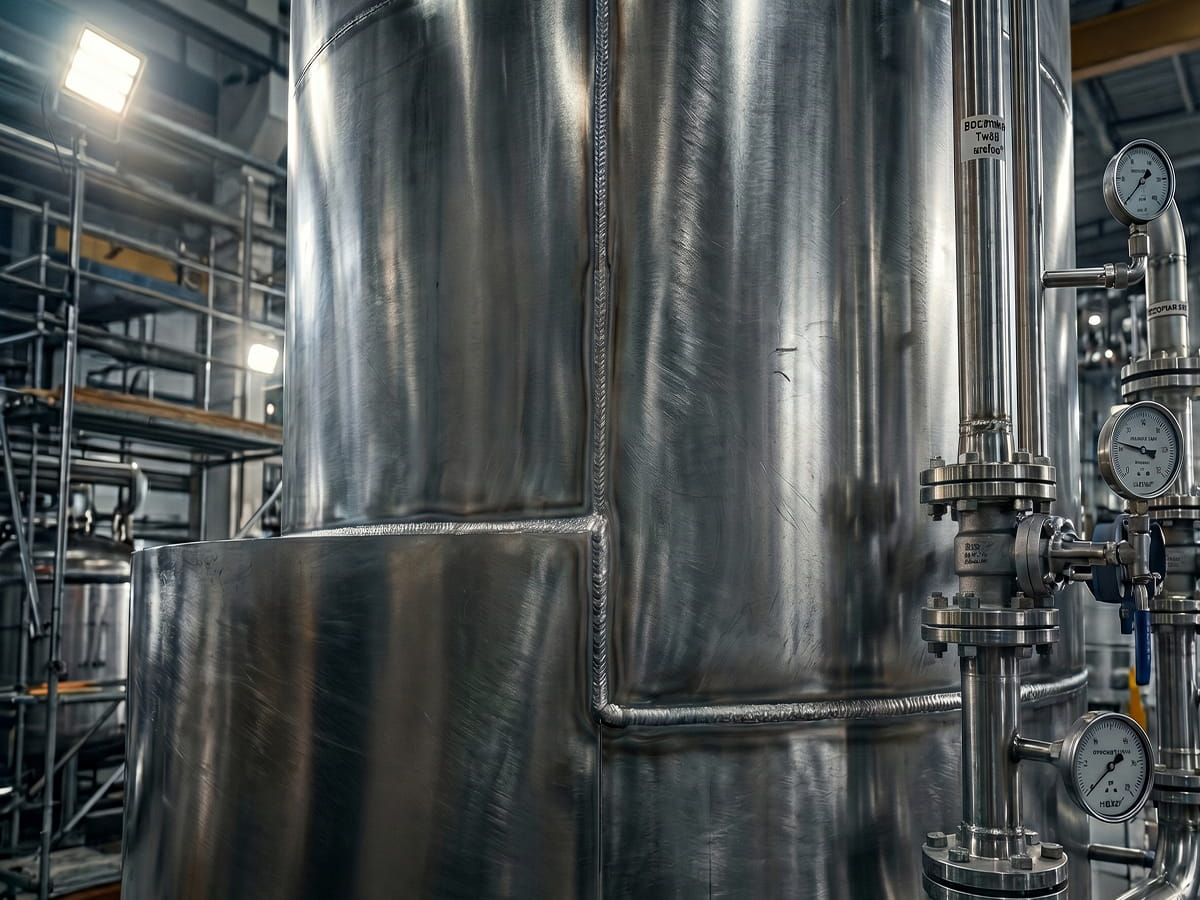
Humanity annually consumes billions of tons of liquid substances of natural and synthetic origin for various purposes. A significant portion of these substances are not transported continuously from the intake points to the final points of use through extensive pipeline networks, but rather undergo several stops along the way for various procedures. For many of these purposes, constructing huge reservoirs with reinforced concrete walls and floors in pits dug into the ground is quite sufficient; however, this relatively simple, albeit expensive, method is not always feasible.
Much more often, large-capacity tanks are required for the transportation and storage of liquids, including oil extracted from the earth and the petroleum products derived from it. The greater the reservoir height, the more difficult it will be to cope with the increasing hydrostatic pressure, requiring more durable materials. The task is further complicated by the presence of aggressive substances, which, in addition to mechanical stress, actively impact the walls of the containers in contact with them.
Therefore, in addition to high strength, chemical resistance is also required, significantly narrowing the range of materials suitable for the intended implementation. A third parameter for eliminating potential solutions is the temperature regime, which can differ significantly from normal conditions due to intense heating in industrial production or excessive cooling during the evaporation of liquefied gases pumped inside under pressure.
Thus, finding materials that effectively resist all three of these destructive factors proves challenging in practice. However, they do exist and are readily available on the modern market for ferrous and non-ferrous rolled metal products, each of which is manufactured by metallurgical plants in accordance with the standards set forth in GOSTs and therefore presumably possesses all the qualities expected by engineers.
Perhaps the most in-demand material for the creation of critical storage tanks today is stainless steel sheet, although the analogues used before it have not lost their relevance, especially when solving some specific problems.
How does stainless steel differ from its analogues?
To understand the differences, it would be helpful to first briefly describe the main advantages of stainless steel sheets:
- The inherent strength of all steel products ensures reliable and long-lasting operation under constant mechanical loads. This is largely facilitated by the strong, sealed seams produced by arc welding. These seams are formed using suitable electrodes and an electric current rectified by a diode bridge and smoothed by a filter made of high-capacity capacitors. There is no need for frequency converters or bulky gas cylinder equipment to create a protective atmosphere above the molten metal.
- The chromium oxide formed on the surface is inert even to very active and aggressive strong mineral acids, therefore, adhering as a dense film to the free metal, it prevents its contact with reagents capable of binding to it.
- The refractory nickel included in the composition has a stabilizing effect on the atomic crystal lattice, which proves to be very useful when used in conditions of both high and low temperatures.
Now we can briefly consider the significant practical differences between the analogues.
Brass sheet
Made from copper-based alloy brass sheet It surpasses stainless steel in thermal conductivity and ductility, but is virtually impossible to weld using simple welding methods. Therefore, it is preferred for applications with low mechanical loads and the need to ensure efficient heat transfer between the media being separated, as well as for producing parts with complex relief configurations during stamping.
Aluminum sheet
Very light and flexible aluminum sheet It is useful when it is necessary to minimize the mass of a tank and give it an aerodynamically advantageous shape during the construction of automobile and railway tanks, and aircraft fuel tanks.
Titanium sheet
It is also lightweight but superior in strength and heat resistance even to stainless steel titanium sheet It copes well with the most complex tasks, for example, in the construction of spaceships and submarines subject to enormous loads, but its rather high cost hinders its widespread applicability.