

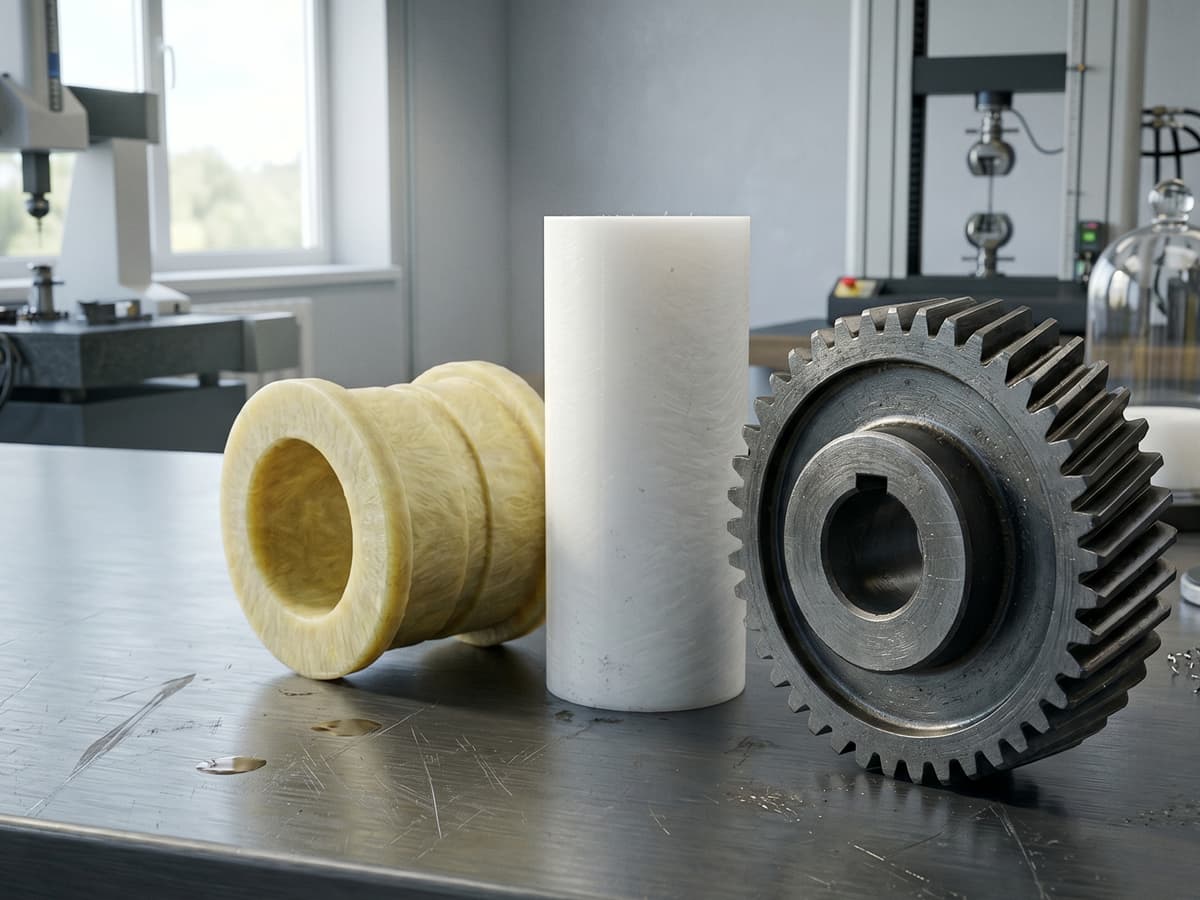
Modern technology involves a vast number of reciprocating or rotating parts that must be held in a strictly defined spatial orientation relative to the rest of the structure. This is impossible to achieve without guide elements, which means it's also impossible to avoid close contact between the constantly shifting parts of the mechanism. This inevitably results in friction, which converts some of the mechanical energy used to perform work into useless, sometimes even harmful, heat.
Friction, as is well known from the laws of mechanics studied in school physics classes, is proportional to the support reaction force, which cannot be reduced under given loads, as well as a coefficient specific to each pair of contacting elements, which can be influenced by carefully aligning the sliding surfaces, introducing lubricant between them, and selecting the materials used for their manufacture. Very good results in reducing friction can be achieved caprolon (polyamide), which has excellent anti-friction properties and good wear resistance, due to which elements made from it serve reliably for a very long period of operation.
The production technology involves the anionic polymerization of liquid caprolactam in the presence of alkalis and catalysts directly in molds, making it quite challenging to ensure that finished products, such as sheets, tubes, and rods, are free of air bubbles. Accordingly, high-quality caprolon, classified as Category A according to the Soviet classification, contains no air bubbles at all, while the less durable Grade B is standardized according to TU 6-05-988-67 only for a visible cross-sectional size of no more than 1.5 mm, but not for their quantity. To improve antifriction properties, a small amount of graphite is added to the initial mixture before polymerization. Graphite acts as a highly effective lubricant due to the very slight shearing of the atomic layers of the crystal lattice, which is clearly visible in the pencil marks left on sheets of paper.
Scope of application of caprolon (polyamide) and its analogues
Polyamide's applications are primarily related to antifriction components, although its low density and chemical resistance to alkalis, salt solutions, and many organic compounds sometimes prove useful in other, non-mechanical applications. Here are just a few examples of caprolon's uses:
Ring linings for disc clutch and braking systems of cars, motorcycles and machine tools are cut from sheets;
tubes are suitable for the production of bushings and liners for plain bearings;
The rods are suitable for turning bodies of revolution with a complex generatrix configuration for high-precision electrical devices.
When using polyamide as insulators, engineers should consider the flow of static charges through electrically conductive graphite when designing and selecting the grade of polyamide. Perhaps some of the alternatives discussed below would be more suitable for improved results.
Polyacetal
When cooled or heated, solids contract or expand according to rather complex formulas that include a coefficient determined experimentally and recorded in reference books. When high dimensional stability is required in the production of mechanical parts polyacetal, which is a product of formaldehyde polymerization. To increase strength, it is pre-incorporated with fiberglass and other fillers. The sheets and rods sold on the market are then machined to produce gears, pulleys, bushings, rollers, and other components.
Ftoroplast
Very slippery fluoroplastic Moreover, it is resistant to high temperatures, making it suitable for heavily loaded friction components without effective heat dissipation. It also boasts high chemical resistance and is harmless to human health, as can be easily demonstrated by the example of cookware made from so-called Teflon, which forms the non-stick coating of frying pans. This is the same substance based on polymerized tetrafluoroethylene, which received different names in Soviet technical literature and by a commercial company whose chemist accidentally discovered it in cylinders of the aforementioned gaseous fluoride of an unsaturated hydrocarbon, which were stored under unusual conditions.
There are also other polymeric materials available commercially, giving engineers plenty to choose from.