

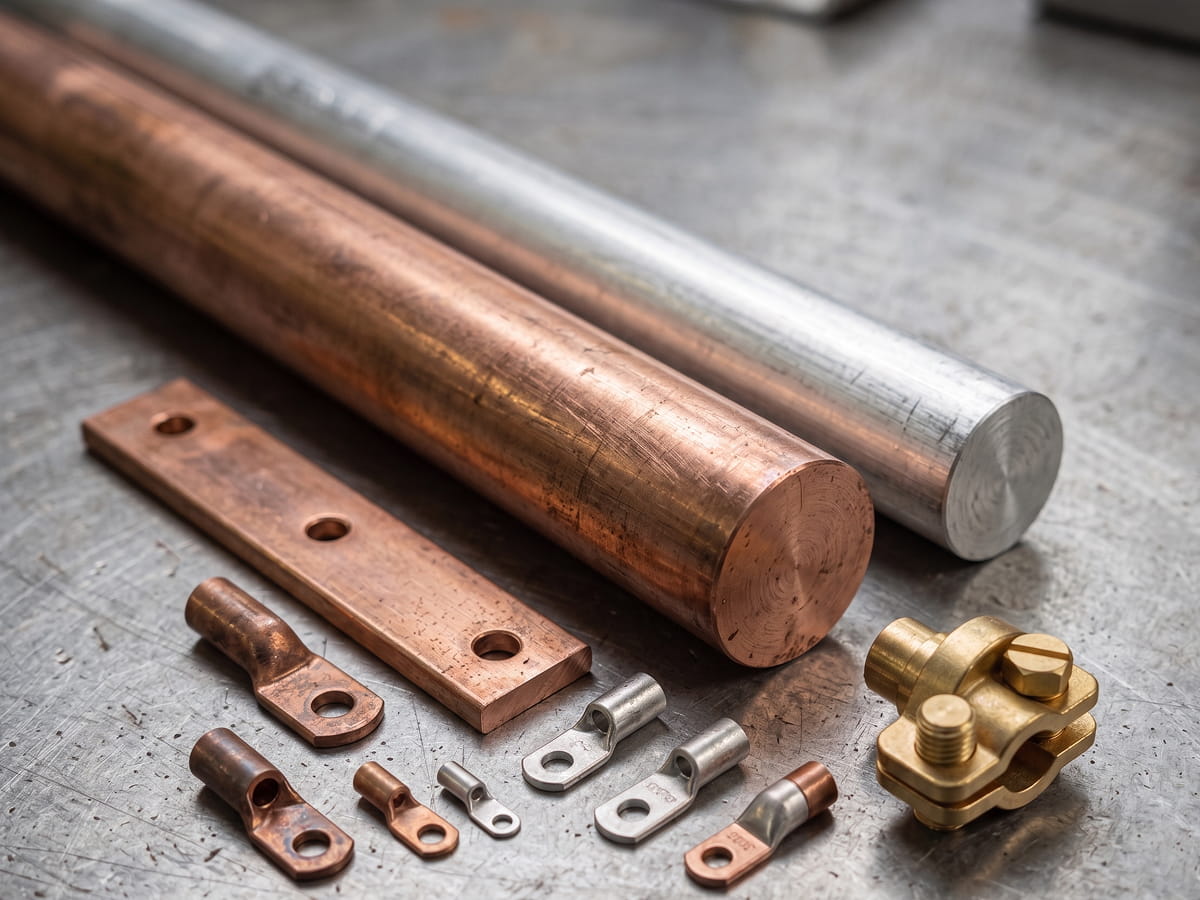
Equipment used in the electrical industry is closely related to the flow of electric current and is used for manual or automatic control of its flow in switching or regulating modes. When constructing electrical circuits, resistivity is the most important technical characteristic for all materials, both natural and synthetic, although many others also play a significant role in practical and economic terms. For the manufacture of conductors, raw materials with low resistivity are typically used, while dielectrics with high resistivity are useful for reliably separating individual sections from each other and insulating them from the environment. Substances classified as semiconductors are rarely used in the production of switching devices and in wiring systems, but they are extremely useful in the creation of modern radio equipment, the capabilities of which today directly depend on the development of technologies for forming interconnected junctions within them according to a pre-designed pattern. The highest currents are encountered in power plants, so it is here that components with minimal active resistance are most often found. Reducing this resistance requires not only selecting materials with high electrical conductivity but also significantly increasing the cross-sectional area, as both of these quantities are present in the formula describing the relationship in inverse proportion to the calculated one. For this reason, the power industry has seen a great demand for non-ferrous metallurgy products manufactured according to state standards developed decades ago and proven over time copper circle, which, for a number of reasons, cannot be replaced at the present time.
What are the advantages of copper wire for the electrical industry?
To fully understand why copper wire is so valuable in electrical engineering, it's worth taking a closer look at some of its properties. Here are the main ones:
- Thermal vibrations of the crystal lattice's atoms and impurities impede the free movement of charged particles under the influence of a force field. At absolute zero, a pure substance is a static structure with regularly alternating layers, between which nothing impedes the movement of particles, resulting in superconductivity. For the most thorough purification, anodizing is performed using electrolysis, which involves transferring anodes cast from contaminated metal into an electrolyte solution and depositing pure copper on the cathode.
- High thermal conductivity also plays an important role, as it allows excess heat to be quickly removed from the conductor into the surrounding environment. This not only protects it from melting, but also maintains its ability to conduct current well due to the stabilization of the crystal's spatial configuration.
- Copper's electropositivity to hydrogen makes it resistant even to the effects of strong mineral acids, not to mention molecular oxygen, water vapor, and salt solutions, which helps preserve parts operating under load in open atmospheres.
In some cases, analogs of the copper circle, which are discussed separately, prove more useful in practice.
Brass and bronze circle
For the production of parts that perform rotational and reciprocating movements during operation and rub against guide elements, it is used brass circle And bronze circle Since the raw material used for their production consists primarily of copper, they inherit all the advantages of the material described above, while acquiring some additional ones. First of all, brass and especially bronze are harder, less ductile, and more malleable, which contributes to more effective resistance to mechanical stress. The antifriction properties of these alloys are also of great value.
Aluminum circle
For some structures, the dead weight is of great importance, which can be significantly reduced by aluminum circle, which is three times less dense and only one and a half times more conductive. It bends very easily at any angle, can be stamped into complex geometric shapes with minimal effort, is easily machined with cutting tools, and is significantly less expensive, so if space is not critical, it is the preferred choice.