Return guaranteeFree exchange/return of goods within - 1 day
Official warranty from the manufacturer - 12 monthsPaymentCash, Visa/MasterCard, payment via Privat24, non-cash settlement
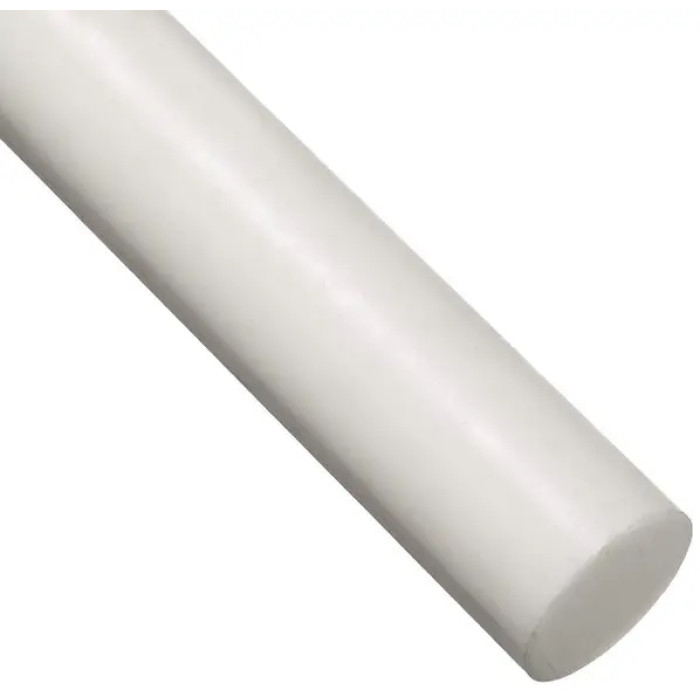
Polybutylene terephthalate (PBT) rod 80х1000 mm This is a heat-resistant and durable engineering plastic used in instrument making, mechanical engineering and electrical engineering. It is created by extrusion from granules of polybutylene terephthalate obtained as a result of polycondensation of terephthalic acid and 1,4-butanediol. The rods have good electrical insulation properties, high rigidity, resistance to oils, moisture and aggressive chemical environments. They are used to make: insulators, bushings, gears, guides and other parts. Sometimes they are reinforced with fiberglass to increase strength.
The main thing
View by manufacturing method
The production of polybutylene terephthalate (PBT) rods involves two main stages: first, the polymer itself is obtained, then the rod is formed from it using extrusion or pressing. They can be reinforced with fiberglass (usually up to 30%) to increase strength and heat resistance.
Chemical composition
Polybutylene terephthalate (PBT) is a thermoplastic polyester belonging to the polyester group. It is formed as a result of the polycondensation of terephthalic acid (or its derivatives) and 1,4-butanediol.
Type by purpose
Used in technical and engineering applications where strength, rigidity, heat resistance and good electrical insulation are required. They are used in such areas as: electronics, electrical engineering, mechanical engineering, automotive engineering and the chemical industry.
A type
Polybutylene terephthalate rod
Dimensions (width, length)
1000 mm
Additional services
Cutting is carried out according to the client's order and packaging of products according to the client's orderSent by any carriers in Ukraine
The country of manufacture
USA
No questions about this product, be the first and ask your question.
Polybutylene terephthalate rods are made from: Ultradur, Pocan, Crastin, Valox, PBT: GF50, Natural, GF30, GF15.
Polybutylene terephthalate rod standards
International standards:
ISO 7792-1 - Thermoplastic polyesters. This standard defines tensile modulus, viscosity, and property classification. It also establishes requirements for processing conditions, coloring, additives, and fillers. This standard is often used as a "data sheet" for PBT pellets, which are then used to produce rods.
ISO 20028-1 is the basis for specifications and designation system for thermoplastic polyesters for extrusion and injection molding. This standard establishes the structure of the material technical specification, a classification system for the main physical and mechanical properties, methods for indicating the field of application, filler coding methods, material identification rules, and a designation system for polyesters.
ASTM D6100 is a standard for molded, extruded, and molded polyacetal resin blanks. This standard regulates inspection and testing methods, manufacturing quality, material requirements, dimensions and tolerances, product labeling, permissible porosity, surface quality, mechanical properties, and product classification.
Polybutylene terephthalate rod weight tables
Diameter, mm
Weight of 1 m, kg
10
0,103
15
0,231
20
0,412
25
0,643
30
0,926
40
1,646
50
2,572
60
3,702
80
6,581
100
10,289
Table of physical properties of polybutylene terephthalate rods
Indicator
Meaning
Density
1,30–1,33 g/cm³
Water absorption (24 hours)
0,08–0,12 %
Friction coefficient
0,25–0,40
Thermal conductivity
0,22–0,30 Wt/(m·К)
Shrinkage
1,5–2,2 %
Table of mechanical properties of polybutylene terephthalate rods