

For electrical engineering, the most important physical characteristic of all substances is their specific resistance to electric current, so it's worth examining the nuances of this process in more detail. Charged particles, exposed to an external field, begin to move at a uniform rate and accelerate until they collide with an atomic nucleus blocking their path, ultimately transferring almost all of their accumulated momentum to it and causing it to oscillate more intensely.
Simply put, in the region of active resistance, electrical energy is converted into heat proportional to its value. Therefore, conductors with an ordered crystalline structure in the interatomic layers offer little resistance to the movement of electrons, and with decreasing temperature, due to the damping of the amplitude of chaotic thermal displacements in the absence of disordered impurities, they even transition to a superconducting state. Isotropic media, on the other hand, due to thorough mixing, have no empty channels for movement; the free path of charges in them is minimal, so they exhibit the properties of practically current-impeding insulators. It is to this type of substance that textolite, which has found wide application in electrical engineering as a reliable and durable dielectric.
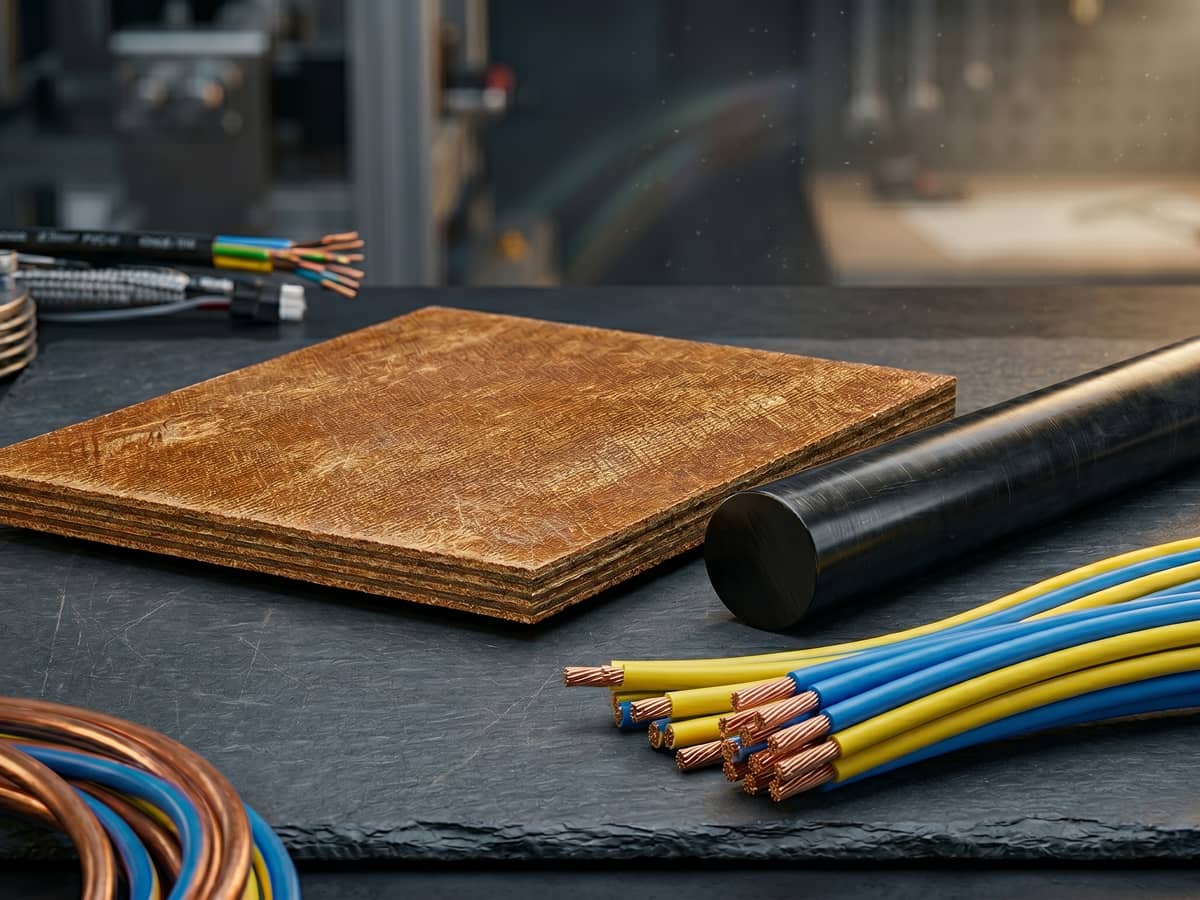
Its production is based on the thorough mixing of natural or synthetic fibers with polymer resins into a thick mass, followed by pressing into products of a given geometric shape. Of the versatile commercially available products, sheets and rods are in high demand, suitable for further processing with cutting tools to produce parts of the desired configurations and sizes. They can be used in a wide variety of equipment:
resistance to oil exposure facilitates the use of oil-filled windings of high-power power transformers for cooling;
insulators turned from rods, in addition to their direct purpose, can simultaneously serve as a structural base for some unit for attaching additional suspended elements;
Good antifriction properties are useful when it is necessary to ensure reliable insulation of moving current-carrying elements while maintaining their specified orientation in space.
By replacing natural and artificial fibers with paper without changing the composition of the binding components, the same technology is used to obtain getinax, so it's equally valuable for electrical engineering. Perhaps the only significant difference is the extremely short length of the cellulose fiber, which means the material doesn't have the same mechanical strength and wear resistance as the previous material. This fact must be taken into account when these factors are important during operation.
Comparison of PCB with other dielectrics
The specifics of problems in electrical engineering are quite broad, so other types of dielectrics, discussed in separate paragraphs, will prove useful for solving some of them.
Ebonite
There are cheaper insulating materials than textolite with a more limited scope of application, but nonetheless quite in demand on the market. These include ebonite, a dark-colored plastic mass obtained by vulcanizing a mixture of purified rubber and sulfur in a 2:1 ratio. It is resistant to acids, making it widely used for battery casings due to its low cost. Its low resistance to solar ultraviolet radiation, high temperatures, and mechanical stress significantly limits its applicability in many applications. However, it is also commercially available in rod form, which is used to machine low-stress insulating elements for various electrical equipment.
Polyvinyl chloride
Connecting individual nodes of electrical networks into a single circuit requires conductors, the vast majority of which are currently made of aluminum and copper, which have very high electrical conductivity. Since significant repulsive forces arise between like-charged particles, they cannot be stopped and accumulated in large quantities in one place. Therefore, after they are supplied and perform useful work, they must be quickly diverted. Therefore, two conductors are required to service each individual device or several connected into a single circuit. Air insulation between them is impractical, so for this purpose, conductors are used.